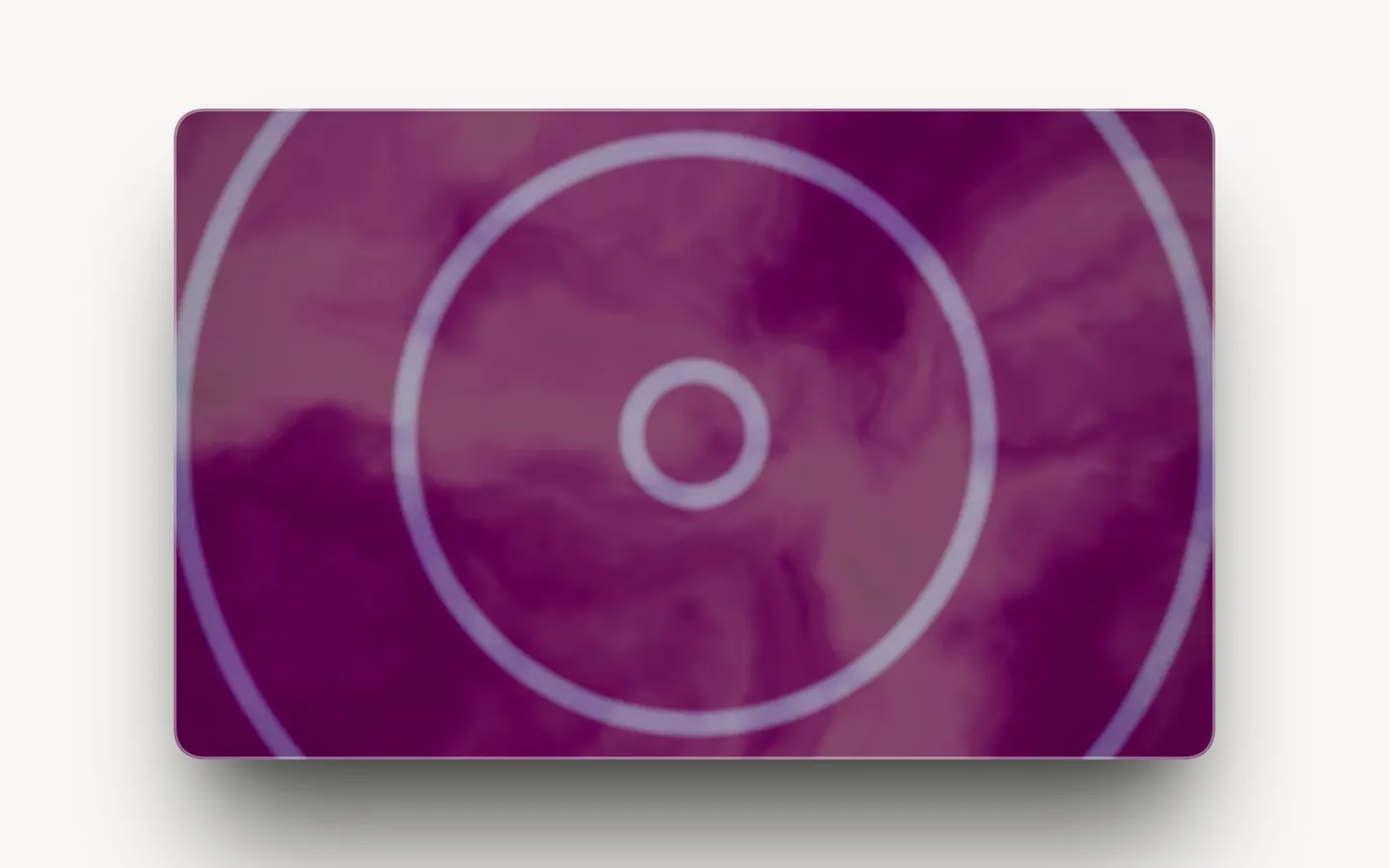
Real-Time WebGL2 Shader Viewport
Synthesizes organic light fields and motion graphics at 60fps directly on the GPU without pre-rendered video files.
Live GLSL Fragment Evaluation
Continuous temporal uniform modulation driving procedural refraction and color grading.

Orbital Distance Fields
Signed-distance field primitives blended with smooth minimum operators and rim lighting.

Uniform Timeline Modulation
Deterministic phase keyframes allow any timestamp to be reproduced with pixel accuracy.

Frame Capture & Export
Captures high-bit-depth WebGL2 frames directly into master video sequences for product launches.
Product architecture and deliverables
How we structured the product, interface system, and engineering workflow.
Procedural Video via Fragment Shaders
Replaces heavy pre-rendered video files with real-time mathematical fragment evaluation in WebGL2.
- Custom GLSL signed-distance and orbital light fields
- Resolution-independent rendering at 60fps
- Zero video compression artifacts in live viewports
Uniform-Driven Keyframe Choreography
Drives camera orbits, chromatic dispersion, and surface tension through deterministic uniform curves.
- Scrubbable temporal uniform buffers (u_time, u_phase)
- Smooth spring and bezier parameter interpolation
- Live shader inspector and preset switching
Deterministic Frame Capture & Encoding
Steps the WebGL2 render loop frame-by-frame to export crisp motion sequences for launch films and keynotes.
- Non-realtime deterministic frame buffer capture
- Pan-DCT and bitrate tier benchmarking
- Seamless handoff between web canvas and video master
Lightweight GPU Memory & Mobile Scaling
Caps device pixel ratio and manages shader precision so complex procedural scenes run smoothly across devices.
- Adaptive pixel ratio scaling on mobile GPUs
- Single-pass fragment pipeline with minimal draw calls
- Clean fallback poster states for low-power mode
More shipped work
All workZyncNode
Operational signal tracking, multi-tenant RBAC, and real-time infrastructure observability designed and engineered for high-velocity engineering teams.
Next →getLeads
A launched B2B prospecting platform combining AI-assisted domain analysis, business compatibility scoring, lead enrichment, and commercial credit workflows.
Start a project
Get started on your next product, website, or launch with our team.